 The Bible makes it very clear that baptism is essential to obtain salvation and become a disciple of Jesus Christ (Mark 16:16; Acts 2:38; 22:16; Matt. 28:19-20; Gal. 3:26-27; 1 Pet. 3:21). Therefore, it is necessary for us to determine the proper mode of baptism, especially since various religious bodies in Christendom define baptism in different ways. Some pour or sprinkle water on people’s heads and say they’ve baptized them; others completely immerse them in water and define that as baptism. Which of these is correct? Or, are both of them correct? Does it really matter?
God told us in his Word that “every word of God is tested…” (Prov. 30:5), and we are not to add to or take away from his Word (Deut. 4:2; Prov. 30:6; 1 Cor. 4:6; Rev. 22:18-19). Therefore, determining the proper definition of baptism is just as important as recognizing that it is scripturally necessary for salvation and forgiveness of sins. After all, if God told us to baptize with a specific act in mind and we do something different, we have not actually obeyed him and thus our eternal salvation is in jeopardy (Heb. 5:9; Matt. 7:21-23).
With this in mind, we must remember that in the first century AD when the Holy Spirit inspired the writers of the New Testament (2 Pet. 1:20-21; Eph. 3:1-5; cf. 2 Tim. 3:16-17; 1 Cor. 14:37), their words were written in Greek. The Greek words they used which in English we read as “baptize” and “baptism” are baptizo and baptisma. Note the similarities between these Greek words and the English words “baptize” and “baptism.” These similarities exist because “baptize” and “baptism” are not actually TRANSLATIONS of the Greek words, but instead are TRANSLITERATIONS (where Greek letters in a word are simply given their English equivalents.) To confirm the actual meanings of baptizo and baptisma, we must go to authorities on the Greek language.
Greek linguistic authorities such as Thayer, Liddel & Scott, Sophocles, Cremer, and Vine all define “baptize” (baptizo) and “baptism” (baptisma) as “to immerse, to plunge, to dip,” “…consisting of the processes of immersion, submersion and emergence.” Not one standard Greek lexicon defines baptizo as “to sprinkle” or “to pour.” In fact, there are completely different Greek words for “pouring” (ekcheo) and “sprinkling” (rhantizo). No, the proper definition of baptism is immersion. When we understand this, it makes the biblical figures of speech used to describe baptism much clearer. When Paul says that we are “buried” with Christ in baptism (Rom. 6:3-4; Col. 2:12), that imagery makes more sense when correlated with actually burying someone in water via immersion rather than sprinkling them with water. How many of us would sprinkle some dirt over someone’s coffin and conclude that we’ve buried them?

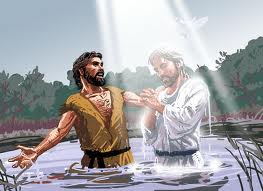
Furthermore, understanding baptism to be immersion in water also gives logic to the actions committed by those who baptized others in the Bible. For example, John the Baptizer (Immerser) chose to baptize at Aenon near Salim…why? The Scriptures specifically give the reason: “…because water was plentiful there…” (John 3:23). If baptism is sprinkling a few drops of water over someone’s head, why would John need to go where there was a lot of water? A single glass of water would be sufficient to sprinkle at least one hundred people. However, one would need a lot of water in order to dip someone’s entire body into it, especially if you needed to do so with hundreds of people.
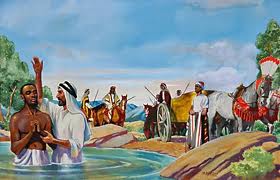
In addition, consider the actions of Philip and the Ethiopian when Philip baptized him. The Bible says that upon finding water and confessing his faith in Christ, the Ethiopian “commanded the chariot to stop, and they both went down into the water, Philip and the eunuch, and he baptized him. And when they came up out of the water, the Spirit of the Lord carried Philip away…” (Acts 8:38-39). If baptism is defined as Philip sprinkling a few drops of water over the eunuch’s head, why would both of them go down into the water and come back out of the water? Why would even one of them need to go down into the water? They both could have stood on the shore while Philip reached down and got his hands sufficiently wet enough to sprinkle some water on the eunuch’s head. In fact, why would the Ethiopian even need to leave the chariot? Philip could have left the chariot, come back with a handful or cupful of water from the oasis, and sprinkled some drops on the eunuch’s head right there in the chariot. However, since baptism required Philip to fully immerse the Ethiopian’s body in water, it makes sense that they would both leave the chariot, go down into the water before baptism, and come up out of the water after baptism. With this in mind, note that Jesus, upon being baptized by John, was also said to come up out of the water (Matt. 3:16; Mark 1:9-10), thus showing that our Lord himself was immersed in water when he was baptized.
Therefore, we must remember whenever we read in our English Bibles the words “baptize” and “baptism” that we are read transliterations of the original Greek words rather than the actual translations which only mean “to immerse” and “immersion,” transliterations that were made most likely to avoid offending those in the religious world who practice pouring or sprinkling instead of immersion. However, the priority of true followers of Christ is to avoid offending God rather than men (Gal. 1:10). To know exactly what his will is, we must use the actual definitions of the words the Holy Spirit inspired the writers of the New Testament to use. May we set aside our fallible human wisdom which puts the actual commandments of God on the back burner in favor of keeping the traditions of men (Matt. 15:1-9; Mark 7:1-13)! Instead, let us keep the actual commandments of God and thereby prove our love for him is true (John 14:15; 15:10, 14; 1 John 5:3).
 Pre-Denominational Christianity
Thank you for your posts. God bless you and your loved ones. As a brother Christian I encourage you to continue doing this ministry.
Thanks for your posts they are so encouraging and enlightening. Thanks again.
Groan … “Not by works of righteousness…” Baptism is a symbol, it is NOT salvific.
“Baptism now saves you…” (1 Pet. 3:21)
“He who believes and is baptized shall be saved…” (Mk. 16:16)
“Rise and be baptized and wash away your sins, calling on his name.” (Acts 22:16)
“Repent and let every one of you be baptized in the name of Jesus Christ for the forgiveness of your sins, and you will receive the gift of the Holy Spirit.” (Acts 2:38)
All of the above passages show that baptism is indeed necessary for salvation/forgiveness of sins, just as much as faith and repentance are necessary.
Those passages are just as biblically legitimate as passages like Ephesians 2:8-9: “For by grace you have been saved through faith. And this is not your own doing; it is the gift of God, not a result of works, so that no one may boast.”
Grace saves us. Faith saves us. We are not saved by our own works. None of us can say, “God, you owe me salvation, because I did a lot of wonderful things, including believe in you with all of my heart, repent of my sins, and be baptized.” Because God will always be able to reply, “Yes, but you also sinned, and the wages of sin is death in hell (Rom. 6:23; Rev. 21:8). So you need my grace; you can’t say that you did this all by yourself.”
But the fact that the Bible says we are saved by grace through faith does not invalidate the fact that the Bible also says that baptism alongside of faith saves us (1 Pet. 3:21; Mk. 16:16) and is necessary along with repentance for forgiveness of sins (Acts 2:38; 22:16).
As for it being symbolic, Acts 8:35-38’s description of baptism doesn’t sound symbolic to me. It sounds like two people literally going into water, the one literally baptizing the other, and then both of them literally coming up out of the water after the literal baptism was over.
Just something to think about, Mr. Wescott. Thank you for your comment.
I appreciate you taking the time to respond, but consider what you might, unintentionally, be doing. A wise churchman of the 1500s, in an effort to quell unnecessary and distracting controversies, made a very useful declaration: “In Essentials, Unity; In Non-essentials, Liberty; In all things, Charity.”
If you look at it closely, you’ll see that repentance and trusting in Christ are the same thing. It’s a turning from sin to Christ. That, according to most of the scriptures that refer to salvation, is all that is required. Baptism should occur as an act of obedience afterward. To be unwilling to publicly declare your salvation would be sin, and would therefore negate the salvation a person was seeking, because repentance would not be complete.
Among the Jews, baptism was an explicit denial of the false works-based religion which the Jews had been practicing for over three hundred years. Should they have been unwilling to be baptized; unwilling to make that public declaration, then their repentance would have been incomplete. And any prayer which they may have made secretly would not bring about salvation. I think Nicodemas and some others among the Pharisees got it right and “went public” with it. I want to believe they were baptized at some point, but scripture is silent on that.
You quoted Mark 16:16, but only partially: the second half of it declares that damnation comes to those who *don’t *believe. In 1 Corinthians 1:14-17, Paul declares himself to be a preacher of the gospel and does not emphasize baptism as a part of that gospel. Indeed, if it was part of the gospel, would not Christ have required Paul to perform it along with the preaching of salvation by grace through faith?
I can see where your theology comes from, but I think it goes too far, and perhaps in a wrong direction. To me, and I don’t really mean this as offensively as you might want to take it, but it seems like you might be “riding a hobbyhorse”. I don’t know if you’re familiar with that term, but it’s when a preacher or a teacher focuses so strongly on one thing that he makes everything else in scripture fit into his view of theology.
I’m sure I won’t convince you of anything, because you wrote the boilerplate that you sent me, and you’ve done this with others over time. So, I won’t continue for long. My concern is that by making the work of baptism a requirement for salvation, you are corrupting grace and thereby misguiding people. If that is true, then you may be sending souls somewhere the thief on the cross never had to go. I pray that the seriousness of such a thought would lead you to reconsider your opinion.
The primary essential in Christianity is getting the doctrine of salvation correct. Otherwise, there would be no people who are saved, and who also, by baptism and continuing in good works, would be, not merely saved, but saved *and *Christian.
My hope is that anyone you speak to would understand that Christ can save without baptism, and that you convincing them otherwise would not interfere with that saving faith by which God’s grace can save them; that your “requirement” of baptism would not confuse them to the point where they depend on it instead of Him. Meanwhile, I am hoping that you, yourself, are a believer and secure in Christ, and in that hope, I pray for God’s blessings upon you.
In order for there to be unity in the essentials, one must first acknowledge what is in fact essential, as I’m sure you’d agree.
If Scripture says something is essential for our salvation, then it logically follows that such is essential.
For example, grace would be essential to our salvation because the Bible specifically says, “By grace you have been saved” (Eph. 2:5).
In like manner, the Bible also says, “Baptism now saves you” (1 Pet. 3:21) and “He who believes and is baptized shall be saved…” (Mk. 16:16).
Thus, baptism, like grace, is essential for salvation. Whether or not unity is achieved over such essential matters is determined by whether one decides to take the Bible for what it says.
Repentance (metanoao) literally means to change one’s mind. Faith (pistis) literally means to have trust and conviction in Christ.
Thus, the two are not the same. In fact, the former is the result of the latter (2 Cor. 7:10-11; James 2:14-26). One will change one’s mind about sin and thus turn from it without first having complete trust in God and his promises.
The Bible says that both are indeed required for salvation (John 3:16; 2 Cor. 7:10). In like manner, the Bible says that baptism also is required for salvation (1 Pet. 3:21; Mk. 16:16; Acts 2:38; 22:16).
Nowhere in the Bible does it say that baptism is an act of obedience that one who is already saved must do, nor does the Bible state that baptism is a public declaration of a salvation already received.
If such was the case, Peter would not have said that “baptism now saves you.” Rather, he would have said, “Baptism is now a public declaration that you have been saved.” But he didn’t say that.
Concerning Mark 16:16, you are correct that the second part of the verse only says, “but he who does not believe will be condemned.”
The question I have for you, asked respectfully, is this. Do you believe the first part of the verse? “He who believes and is baptized shall be saved…”
Because if you do not believe the first part of the verse, does that not make the second part of the verse applicable to you? “but he who does not believe will be condemned.”
Something to think about, Mr. Wescott.
Concerning 1 Cor. 1:14-17, the context of the passage shows that the Corinthians were placing undue allegiance to the people who had taught and baptized them (1:10-13; cf. Acts 18:1-8), which is why Paul was thankful he had baptized only a few of them, meaning that only a few of them were giving him undue allegiance.
An examination of the entirety of his writings and statements shows that he did indeed place great emphasis on the necessity of baptism for salvation and forgiveness of sins (Rom. 6:3-5; Col. 2:12; Acts 22:16) due to the Lord teaching him to do so (Matt. 28:19-20; Gal. 1:11-12; 1 Cor. 14:37).
His statement, “For Christ did not send me to baptize,” taken in its context, is therefore meant to refute the undue loyalty the Corinthians were placing upon the different people who had baptized them. It is not meant to suggest that baptism is not essential for salvation.
The very fact that Paul acknowledges that he had baptized some of them shows that “For Christ did not send me to baptize” does not mean that Christ had told Paul that baptism was not necessary.
See my article for more information on this: https://predenominationalchristianity.com/2012/10/23/baptism-was-paul-against-it/
My theology concerning baptism is based simply on the fact that the Bible says quite plainly that baptism is necessary for salvation and forgiveness of sins, just as it also says quite plainly that such things as grace, Christ’s sacrifice, God’s love, faith, repentance, obedience, etc., are also essential for salvation. I’m simply taking the Bible for what it says.
With respect, I do not see that you are doing the same, since nowhere does the Bible talk about baptism in the ways you have promoted.
I do not take offense at anything you’ve said. I appreciate the discussion.
As for the suggestion that I’m riding a hobbyhorse, I respond by asking you to take a few minutes to go through my blog. You will see several articles on baptism, yes. However, you will also see that there are even more articles which cover many other biblical subjects.
You’ll also see that on this and other subjects, I go out of my way to bring out everything that God’s Word says about the matter (Ps. 119:160; 2 Tim. 2:15).
Thus, I’m placing no undue over-emphasis on this topic, which is what riding a hobbyhorse requires. Nor am I focusing on it so strongly that I am practicing eisegesis rather than exegesis concerning it, meaning that I’m making the Bible fit my own preconceived notions rather than simply taking the Bible for what it says.
I write these “boilerplates” not because I’m sure I’ll convince you (I’m pretty sure I won’t), but because others who cared enough to read the comments might care enough to read not only your disagreements but my responses. For those who do care enough to read this far, I write this to get them to consider what the Bible says on this matter, just as I’ve written it for you to do as well. Whether or not that happens is between the reader and the Lord.
But to respond to your concerns, all I’m doing is bringing out the passages that plainly state that baptism is essential for salvation. By doing so, it is not I who make baptism a requirement for salvation; it is the Lord. And by him doing so, grace is not in any way corrupted.
The same Lord who forgave the thief on the cross without requiring him to be baptized, and did so before his death while the old covenant was still in effect, then commanded baptism for salvation after his death and resurrection (Mk. 16:16), when the new covenant was put into effect (Heb. 9:15-17).
We live under that new covenant. Therefore, Jesus has directed us to be baptized in order to be saved. Let’s simply take him at his word.
You are very much correct in saying that the primary essential in Christianity is getting the doctrine of salvation correct.
All I’m doing is simply pointing out what Scripture says is essential for salvation. 1 Peter 3:21, Mark 16:16, Acts 2:38, Acts 22:16…all specifically include baptism as something which must be done in order to be saved and have sins forgiven, just as much as other passages show that things like grace, repentance, and faith are necessary for salvation.
I urge you and the other readers to keep that in mind. Whether or not you accept what Scripture says is between you and God. All I can do is point out what it says.
Again, I appreciate the comments and the dialogue.